


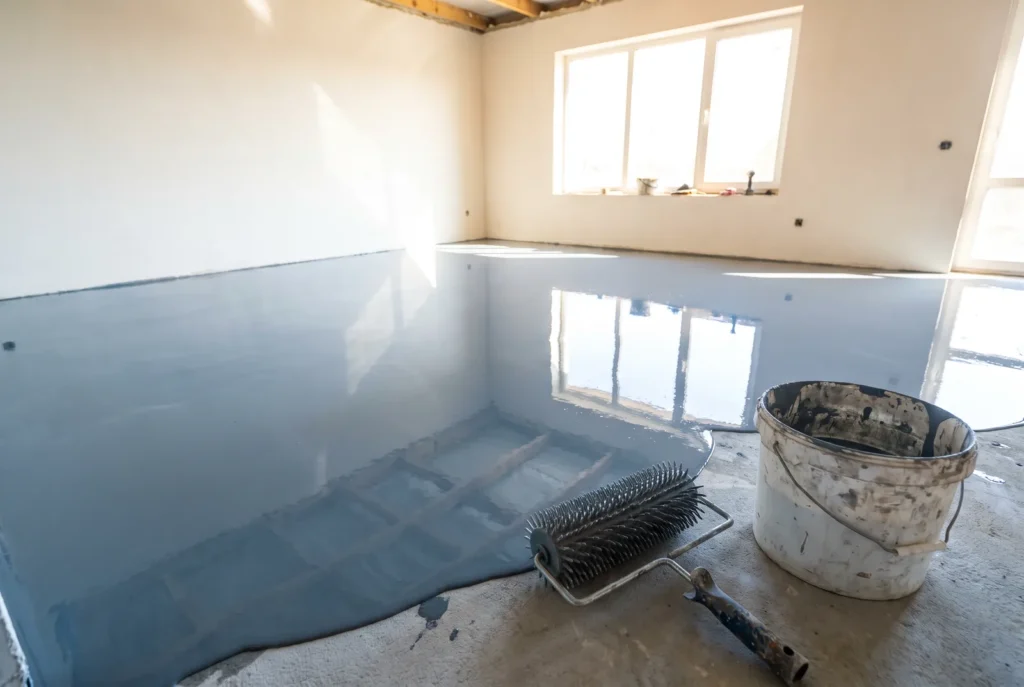
Before laying a wood floor or tiles, the substrate must be flat, dry and sound. Two solutions depending on the scale of the defects: self-levelling compound (millimetres) or a screed (centimetres). Choosing wrong is expensive — here is how to decide, based on the French reference documents (DTU 26.2 for screeds and the CSTB specifications for P3/P4 compounds).
First: measure with a 2 m rule
Lay a 2 m mason's rule on the floor, in a star pattern across both diagonals. The maximum gap under the rule decides everything:
| Defect under the 2 m rule | Solution | Thickness |
|---|---|---|
| ≤ 5 mm | Floating wood floor possible directly (7 mm tolerated by some manufacturers) | — |
| 5 to 20 mm | Standard or fibre-reinforced self-levelling compound | 3 to 20 mm depending on product |
| 20 to 40 mm | Thick levelling compound | up to 40 mm (specific products) |
| > 40 mm, slope, very uneven timber floor | Screed (traditional, liquid) or dry screed | 50 mm and more |
The typical build-up before a wood floor
Self-levelling compound: fast and thin
- Class P3: normal domestic traffic — the standard. P4/P4S: heavy traffic or timber substrates.
- Fibre-reinforced is mandatory on: old tiles, timber floors, slabs with adhesive residues.
- Bonding primer always, matched to the substrate (porous or closed).
- Consumption: 1.5 kg/m² per mm of thickness. A 20 m² room levelled by 8 mm = 240 kg of powder — plan the handling.
- Delays before wood floor: walkable at 3-4 h, floating floor 24-72 h, glued-down installation 7 days (check the datasheet).
The screed: starting from scratch
- Traditional (mortar struck off with a rule): minimum thickness 50 mm unbonded or floating. Drying: 1 week per cm up to 40 mm, then 2 weeks per cm — 6 to 10 real weeks before a wood floor.
- Liquid anhydrite screed: excellent flatness, ideal over underfloor heating, but requires sanding off the surface skin and moisture ≤ 0.5 % (carbide test) before any covering.
- Dry screed (granules + boards): zero drying time, ideal over old timber floors — wood floor can go down the next day.
Trap number 1: residual moisture
A substrate that feels dry is not dry at its core. Before a wood floor: ≤ 3 % (cement substrate) or ≤ 0.5 % (anhydrite), measured with a carbide meter — a pin meter only gives a trend. Laying too early condemns the wood: it absorbs the screed's moisture and cups. See our wood floor acclimatisation protocol.
The exact tolerances on the wood floor side are in substrate levelling and flatness. Flat, dry floor: you are ready to choose your installation method.