


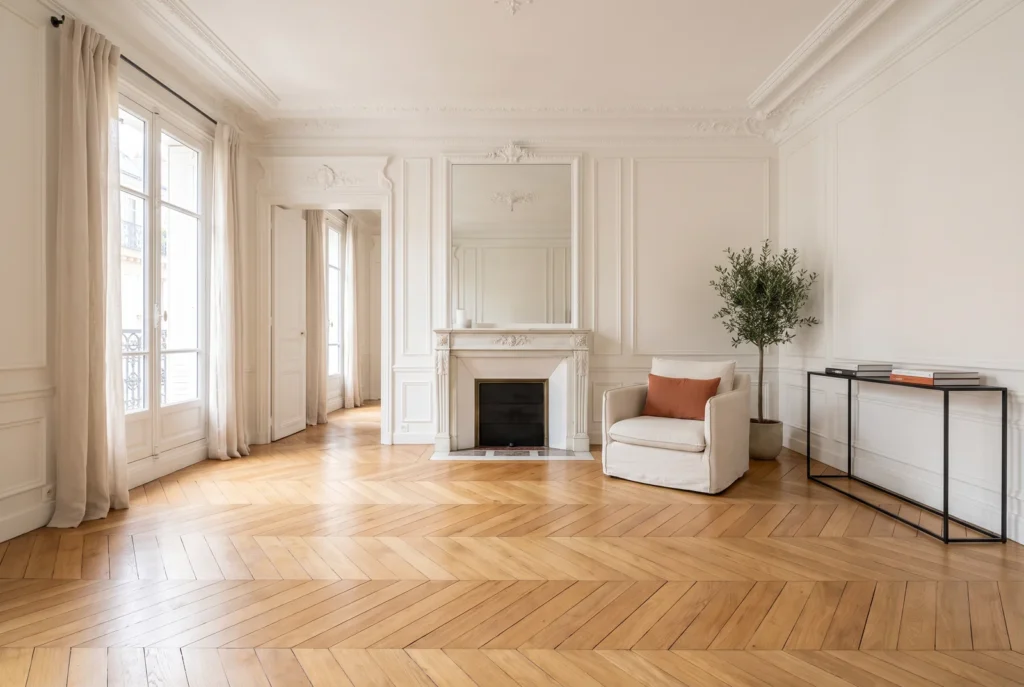
Herringbone and chevron look alike in a thumbnail and are nothing alike on a floor. The difference lies in how the ends of each board are cut, and that single detail changes the look, the price and the amount of waste. Here is how to tell them apart.
Herringbone: square ends, right angles
The boards are plain rectangles with square-cut ends. They are laid at right angles to one another, each one offset against its neighbour so that the end of one meets the side of the next.
The result is a broken, staggered zigzag. Look closely at the top of the pattern: you see small steps, never a continuous line. That stepped edge is the signature of herringbone.
Chevron: angled cuts, continuous points
Here each board is cut at an angle at both ends — usually 45° or 60°. Laid end to end, the boards form perfect Vs, and the points line up into unbroken rows running the length of the room.
The look is sharper and more formal than herringbone. In French this pattern is called point de Hongrie, which is why English-language catalogues sometimes label it Hungarian point.
The three-second test
Follow the line where two boards meet at the top of a V.
- The line breaks and steps across the floor → herringbone.
- The line runs straight and unbroken from wall to wall → chevron.
Straight plank: the third option
Often mentioned alongside the other two, straight plank is simply boards laid parallel. It is quieter, cheaper to install, generates the least waste, and lets the grain of the wood speak for itself. It remains by far the most common choice.
What it costs
| Pattern | Waste | Installation |
|---|---|---|
| Straight plank | 5-8 % | Standard |
| Herringbone | 10-15 % | Skilled, slower |
| Chevron | 12-15 % | The most demanding |
The angled cuts of a chevron produce offcuts that can almost never be reused, which is why the waste allowance is the highest of the three. Add to that the setting-out: a chevron started half a degree out of true drifts visibly across the room.
Which room suits which
- Small rooms — straight plank. A geometric pattern needs floor area to read; below 15 m² it is simply cut away at every wall.
- Long corridors — herringbone works, chevron rarely does: its points draw the eye down the length and stretch the tunnel effect.
- Large, well-lit rooms — chevron comes into its own, particularly under high ceilings.
- Period properties — herringbone reads as classic, chevron as formal.
One practical point
Both patterns must be laid fully bonded onto a flat, dry substrate. Neither is available as a click-fit floating floor in any serious form. Budget for the levelling compound as well as the boards.
See it before you commit
A 20 cm board tells you about the wood, not about the pattern. If you are weighing herringbone against chevron, come and see a laid surface — the difference is obvious in person and invisible on screen.