


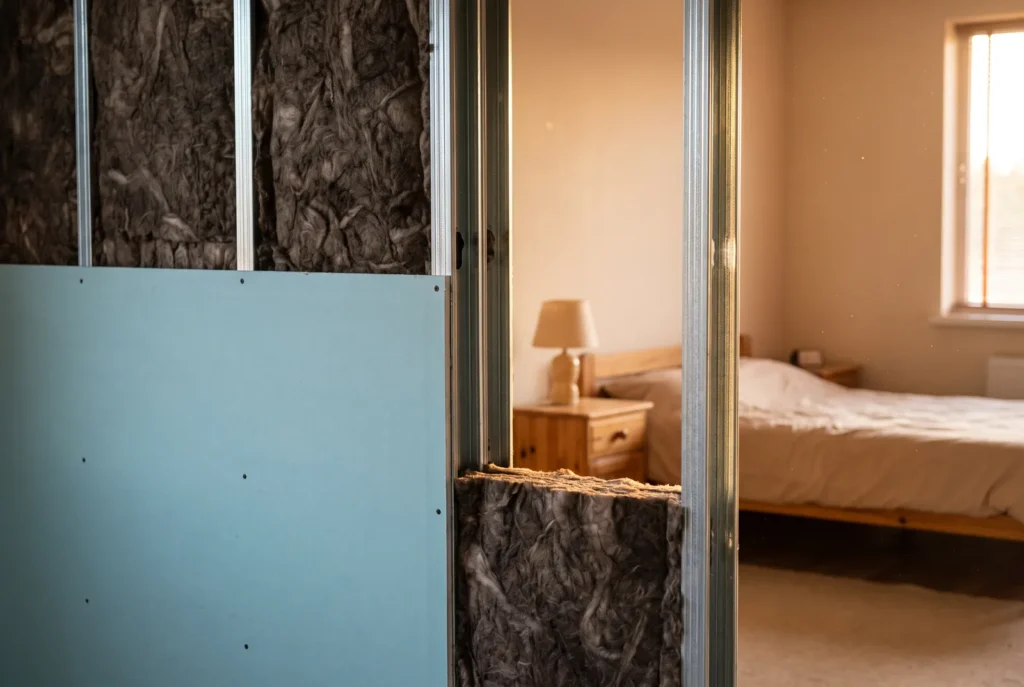
Soundproofing is the most misunderstood job in renovation: people glue on two boards and are surprised they still hear the neighbour's TV. Sound is not blocked, it is damped — and each type of noise has its own solution. Here are the principles, the regulatory benchmarks and the real measured gains.
The regulatory benchmarks (dwellings)
- Airborne noise between dwellings: insulation DnT,A ≥ 53 dB required in new French builds — an old building is often at 40-45 dB, hence the voices you hear.
- Impact noise: received level L'nT,w ≤ 58 dB in new builds. Every 10 dB gained is perceived as halving the noise.
Identify the noise before treating it
| Type | Examples | Effective treatment | Realistic gain |
|---|---|---|---|
| Airborne | Voices, TV, music | Decoupled lining + wool + 2 boards incl. 1 acoustic | +15 to 20 dB |
| Impact | Footsteps, chairs, dropped objects | Acoustic underlay beneath the floating floor | ΔLw 17 to 20 dB |
| Equipment | Pipework, ventilation, lift | Anti-vibration clamps, lined boxings, sleeves | variable |
| Glued ‘miracle panel' | — | Thin foams sold as acoustic | +2 to 3 dB: next to nothing |
The principle that works: mass-spring-mass
A lining on an independent frame or anti-vibration mounts, filled with wool, closed with two boards including one high-density, commonly gains 15 to 20 dB — the difference between ‘hearing everything' and ‘occasionally guessing'. Mass counts: doubling the boarding gains another ~3 dB.
Against impact noise: treat the floor
The floor is where it is all decided. In a flat, an acoustic underlay beneath a floating wood floor (cork, wood fibre, high-density foam) attenuates 17 to 20 dB of impact noise transmitted downstairs — often a requirement of the building's rules (a minimum ΔLw is imposed). Our guide to choosing your underlay compares the materials with figures, and wood floors in apartment buildings details the rules.
The ceiling: the box within the box
Against the footsteps of the neighbour above (if they refuse to treat their floor): suspended ceiling on anti-vibration hangers, 10-15 cm of wool, double board including one acoustic. Real gain of 8 to 15 dB depending on the floor — at the cost of 12 to 18 cm of height.
The golden rule: no sound bridge
Sound passes through the weakest link: a back-to-back socket, an unsealed pipe penetration, a board in hard contact with the structure. Every perimeter junction is treated with acoustic sealant (never rigid filler at the perimeter). Insulation that is 95 % airtight does not give 95 % of the result — it gives 50.