


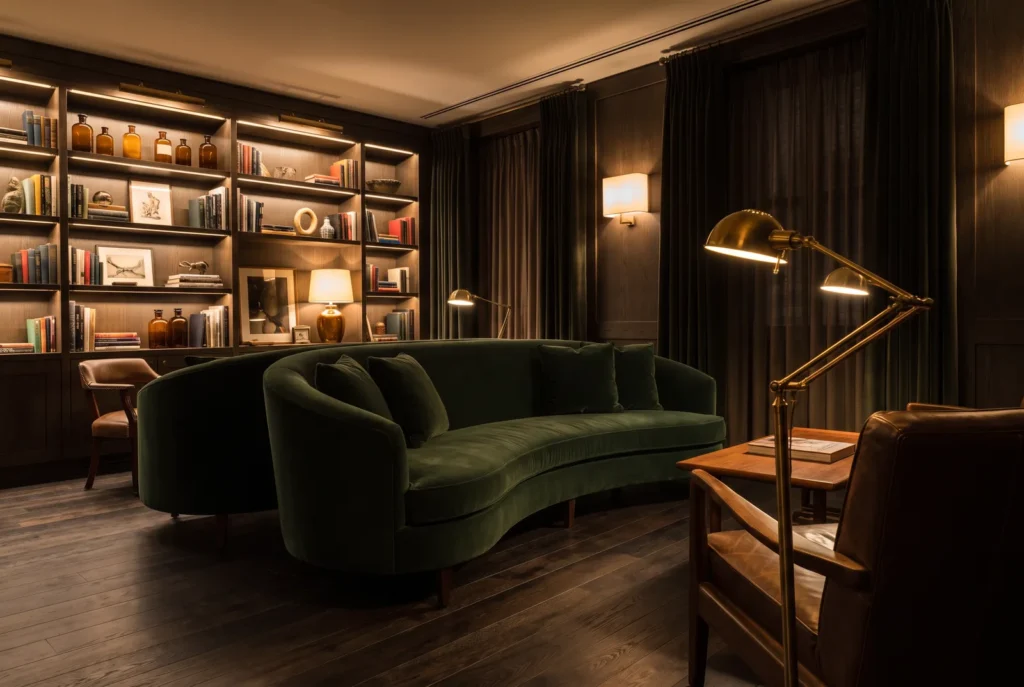
There is a reason hotel bars, libraries and smoking rooms almost always have dark floors: dark absorbs light instead of returning it, and the space tightens around you — in the pleasant sense. A room with a smoked floor is not smaller: it is denser, more intimate, better dressed.
Smoked is not stained
True smoked oak does not come out of a tin: it goes through an ammonia chamber, where the tannins react and brown through the thickness. Colour varies board to board, from havana to deep brown, with nuances surface stains cannot imitate — and a scratch never reveals pale wood underneath. That natural shimmer is what makes the hushed mood.
The contrast rules
- Dark floor, pale walls: the safe formula — the room keeps its height, the floor anchors it.
- Dark floor, coloured walls (forest green, terracotta, midnight blue): the assumed cocoon — keep it for evening rooms: lounge, bedroom, dining room.
- Warm textiles: wool, velvet, leather — smoked oak loves them all; pure white and chrome, less so.
- Low, warm lighting (2700 K): lamps at seat height rather than a ceiling light — dark floors come alive in raking light.
Where to dare, where to dose
A bright living room, a bedroom, a study: ideal ground. A windowless hallway or a north-facing room: better a light smoked tone — the halfway step that warms without darkening. And upkeep? Contrary to legend, a matte brushed smoked floor forgives a lot: dust shows mostly on glossy, smooth finishes. In a full renovation, think of the winning duo: smoked floor down, the rest of the works in our order of works.
From light smoked to deep brown, our smoked oaks in wide planks are in the Smoked collection — and the aged, period moods in the Heritage collection.