


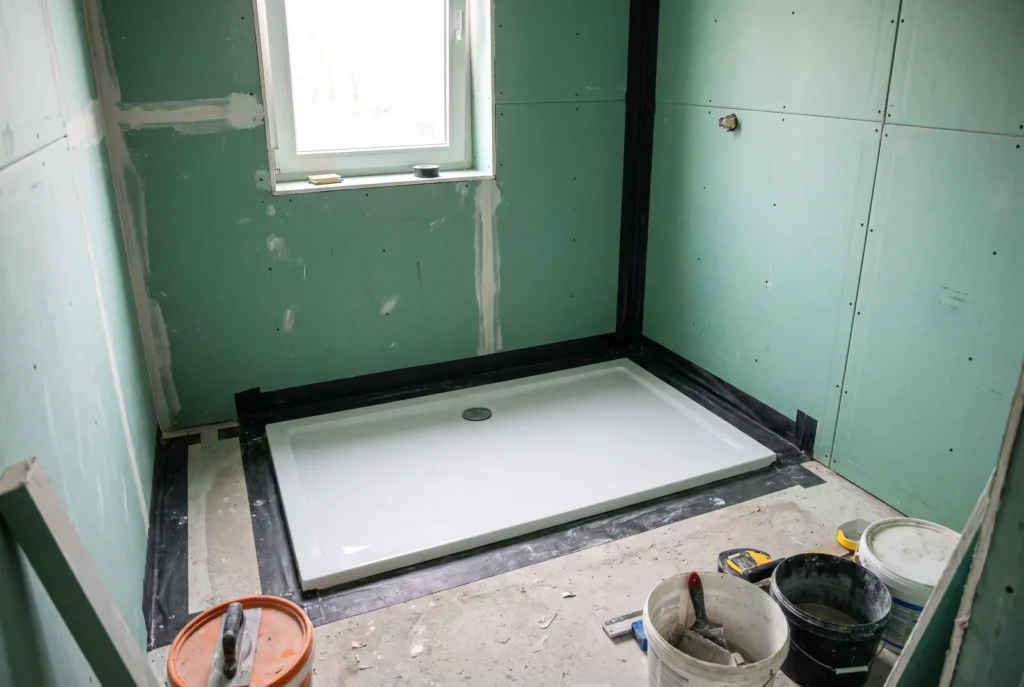
A plasterboard bathroom lasts for decades — on three conditions: the right board, waterproofing in the right places, suitable joints. The rules, summarised.
Room exposure classes
| Room | Class | Board requirement |
|---|---|---|
| Kitchen, WC, utility | Low exposure | Standard board allowed (moisture-resistant advised in kitchens) |
| Family bathroom | Private wet room | Moisture-resistant board everywhere, walls and ceiling |
| Communal showers, spa | High exposure | Specific systems (beyond ordinary housing) |
The shower zone: waterproofing is mandatory
The 5 execution rules
- Moisture-resistant (green) board on the walls AND ceiling of the bathroom — steam rises.
- Under tiles in the shower zone: liquid or sheet waterproofing membrane over the whole splash zone, corners treated with sealing band.
- Partition foot: the track sits on a finished waterproof floor, never where water pools.
- Pipe penetrations: bonded flexible sleeves, not just silicone.
- Ventilation: without effective mechanical ventilation, even the green board eventually suffers.
And the floor? Well-chosen wood copes with a wet room: see wood flooring in the bathroom. The water networks are in our plumbing guide.