


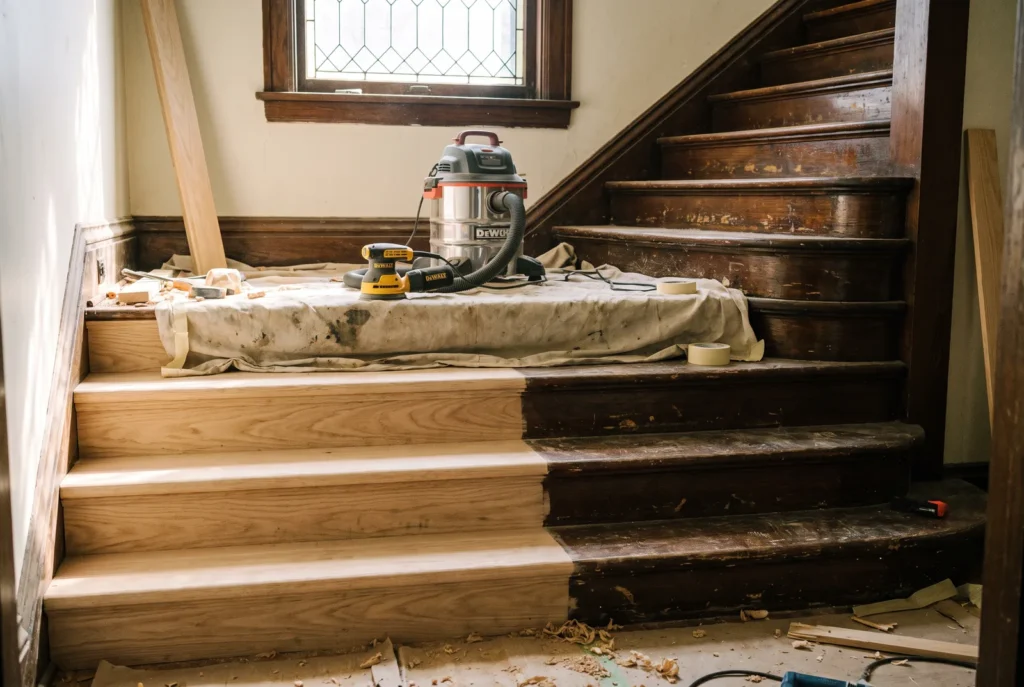
Replacing a staircase costs a fortune; renovating one takes a long weekend. Creaks, worn steps, tired finish: here are the remedies, from simplest to most complete.
First, understand: the Blondel geometry
Creaks: the real cure
- The noise comes from play between tread and riser (or stringer). From behind if accessible: glued-and-screwed blocks in the tread/riser angle. From the front: countersunk pull-up screws through the riser + timber plugs.
- Talc in the gaps: a three-week fix, not a repair.
Resurfacing
- Strip/sand: grit 40 → 80 → 120 (orbital sander + scraper in the corners). Nosings hollowed beyond 3-4 mm: resurfacing or cladding.
- Finish of your choice: staircase-grade sealer (2-3 coats, the toughest), oil (locally repairable, warmer — same logic as for a wood floor), or floor paint on the risers for contrast.
- Keeping it usable: seal every other step, or work at night (16 h drying).
Cladding: the second life
- Steps too damaged: cladding kits in solid or engineered oak (13-14 mm with integrated nosing) glued over the existing — the staircase looks new in 2 days. Note: +14 mm on the first step changes the rise, to be compensated at the bottom.
- The full step-by-step method is in our guide to wood flooring on a staircase.
- Safety: handrail at 90 cm, nothing protruding into the walking path — and well-designed flight lighting (lighting guide).