


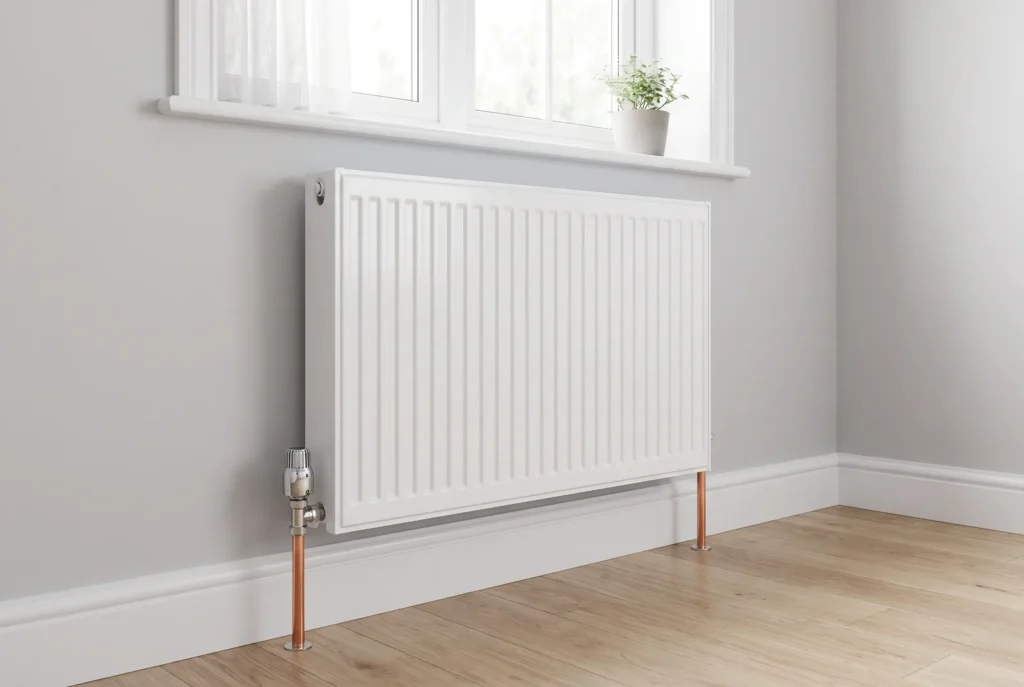
An undersized radiator heats continuously without ever getting there; oversized, it costs money and cycles. Sizing takes three minutes per room — here is the heating engineers' simplified method.
Power per room
| Home insulation | Indicative power |
|---|---|
| Old, uninsulated | ≈ 100 W/m³… insulate first! |
| 1990s-2000s renovation | ≈ 70-85 W/m³ |
| Well renovated (walls R ≥ 3.7, loft R ≥ 7) | ≈ 40-60 W/m³ |
Example: 12 m² bedroom × 2.5 m = 30 m³, well-renovated home → 30 × 50 = 1,500 W. Add ~10 % for a north façade or corner room.
Delta T: reading labels without being fooled
Catalogue output is given at ΔT50 (water at 70/50 °C). With a heat pump or low-temperature condensing boiler (ΔT30), the same radiator delivers only ~50 %: you must therefore oversize by about half on a heat pump — or switch to underfloor heating, built for low temperatures.
Placement (diagram)
The finishing touches that change everything
- Thermostatic valves everywhere except the room with the main thermostat.
- Balancing: lockshield valves throttled on radiators close to the boiler, or the far rooms stay cold.
- Bleed every autumn; sludge → power-flush every 8-10 years.
- Fixing: a full 1,500 W steel radiator weighs 30-45 kg — on plasterboard, see fixing heavy loads.