


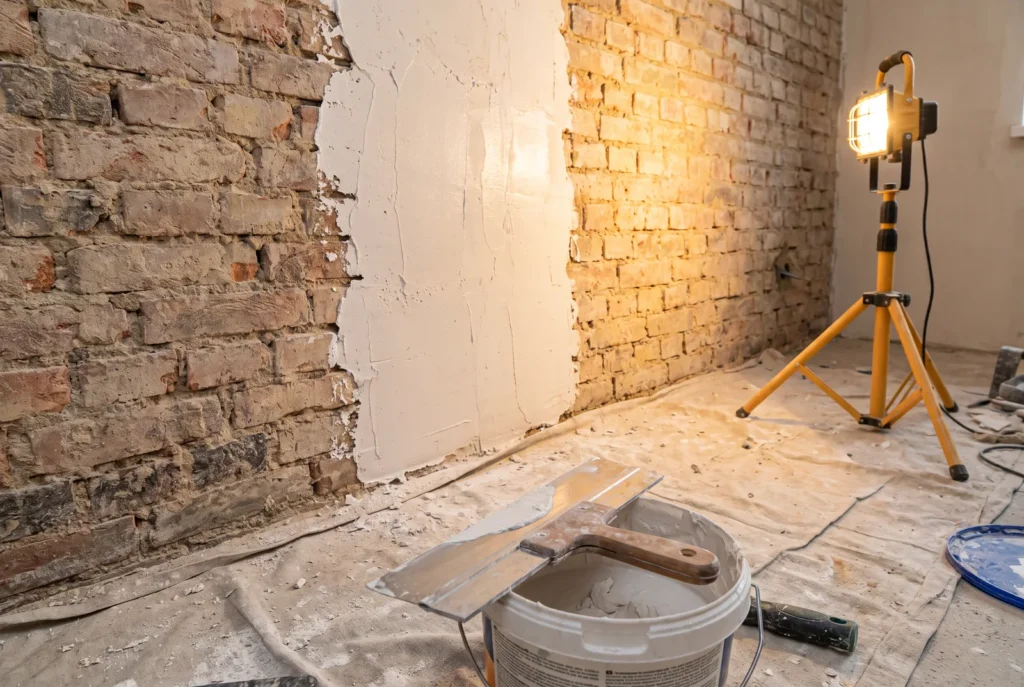
Between the hole-riddled old wall and a full plasterboard lining, there is a middle path, economical and effective: compound. Two products, two moves — fill then skim — and a wall looks thirty years younger.
Diagnosis: skim or line?
- Skim: holes, fine cracks, old marks, small irregularities < 5 mm — the wall is sound and solid.
- Line with insulated plasterboard: damp, badly deformed or crumbly wall, or insulation needed.
- A recurring or traversing crack: treat the cause (structure) before any filler — see also the co-ownership rules.
The two compounds and their roles
| Product | Thickness | Use |
|---|---|---|
| Filler (powder) | up to 20-50 mm in several passes | Holes, chases, chips — fills without shrinking |
| Finishing compound (paste or fine powder) | 0 to 3 mm | The final veil that unifies the whole wall |
The skimming move (diagram)
The method
- Prepare: wash down (degrease), scrape whatever flakes, stabilising primer on porous or chalking substrates — without it the compound ‘burns' and peels.
- Fill, let dry, cut back flush. Cracks: open in a V, dampen, fill, scrim tape over recurring dead cracks.
- Skim in 2 thin crossed passes rather than one thick one.
- Sand grit 120-150, dust off, then primer and paint — the follow-up in painting after compound.