


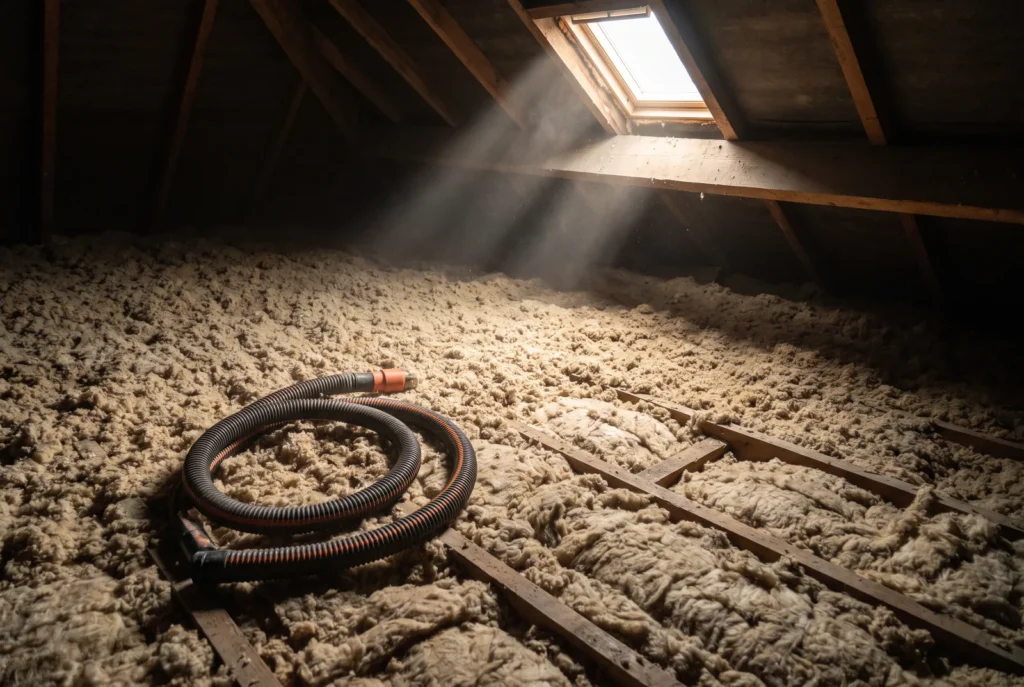
It is the best-yield insulation of the whole renovation: up to 30 % of heat losses go through the roof, and an unused loft is insulated in half a day by blowing. The figures and the traps.
The thicknesses that count
| Target | R (m².K/W) | Blown wool (λ 0.040) |
|---|---|---|
| Subsidy minimum (French schemes) | R ≥ 7 | ≈ 28-32 cm |
| Enhanced comfort | R 8 to 10 | 32-40 cm |
The typical section (diagram)
The execution rules
- Continuity: the wool covers everything, including above the hatch (insulated cover) — 5 % of surface forgotten = 20 % of performance lost.
- Detail points: covers over recessed spots, clearance around flues, depth-marker rulers to check the blown thickness.
- Roof ventilation preserved: never block the eaves air inlets (baffles).
- Vapour barrier on the warm side over light ceilings; in converted lofts, a different technique applies (under-rafter insulation).
- Electrics: cables buried under 30 cm of wool run hot — route them above or in conduit, see electrical conduits.
Loft done = the biggest leak closed. Walls come next (internal lining), then floor comfort — a wood floor over underfloor heating in a well-insulated house is the low-energy combo.