


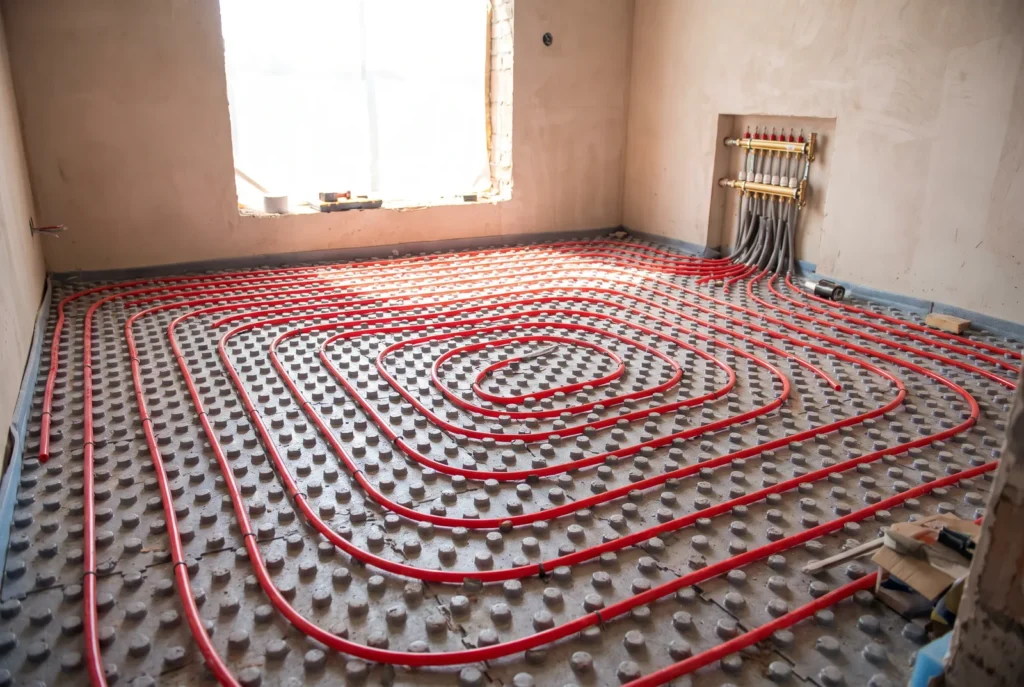
Hydronic underfloor heating (low temperature, ≤ 28 °C at the surface) is absolute comfort in a major renovation — provided you respect the build-up, the embedding and above all the heat-up before any covering. Summary.
The build-up (diagram)
The installation rules
- Insulation under the pipes mandatory (castellated or flat panels + staples), compressible perimeter strip on every wall.
- Pipe spacing: 10 to 20 cm (tightened to 10 along cold perimeters and glazing).
- Loops ≤ 100-120 m, one per zone, connected to a manifold with flow meters for balancing.
- Pressure test before pouring (6 bar, pipes kept under pressure during the pour to reveal any crushing).
- Embedding screed: ≥ 35 mm above the crown of the pipe; liquid anhydrite screed embeds best (no air pockets).
The first heat-up: the step everyone wants to skip
Before ANY covering: gradual heat-up (+5 °C/day to service temperature, hold 3 days, ramp down), at the earliest 21 days after a cement pour (7 days anhydrite). Then off or lukewarm for the installation. This cycle drives out residual moisture — the real life insurance of your future wood floor, together with the moisture measurement (protocol here).
On the covering side: engineered wood is the flooring made for heated floors — species, thicknesses and resistances in wood flooring and underfloor heating.