


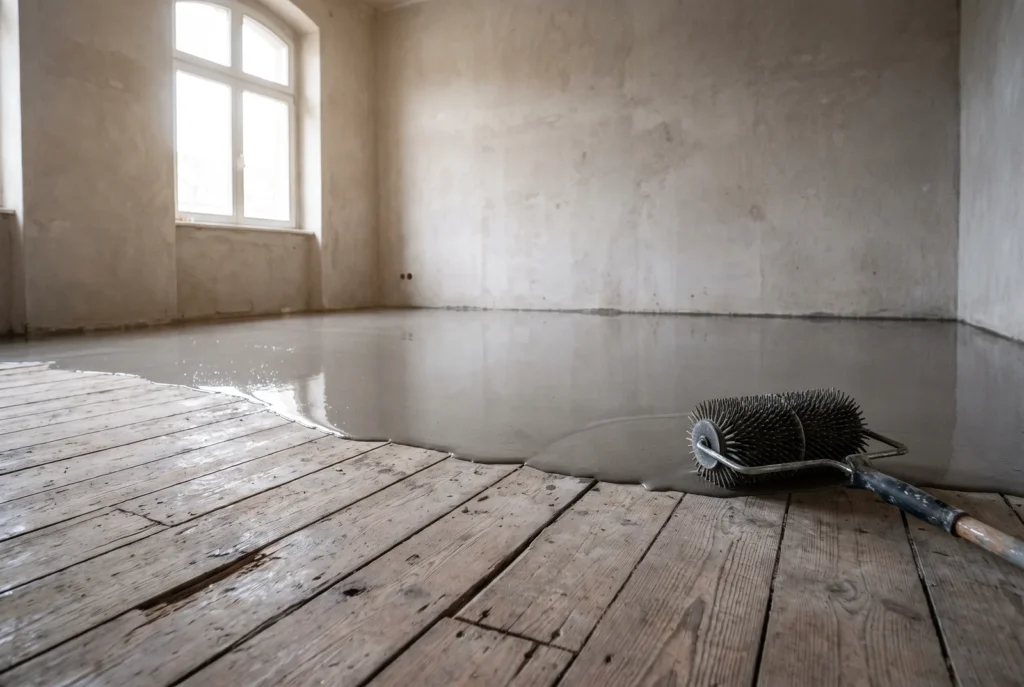
An old creaking, undulating timber floor does not force you to rip everything out: a well-prepared fibre-reinforced levelling compound turns it into a new substrate for a floating or glued wood floor. Provided you first fix what moves. Summary.
Step 1: refix what moves
- Every creaking board = screwed into the joist (countersunk wood screws, never nails that will back out).
- Rotten or deeply worn boards: replaced like-for-like (compound does not fix a dead board).
- Wax/varnish: rough sanding (grit 40) to open the wood — the primer must grip.
The build-up (diagram)
The rules for compound over timber
- Always fibre-reinforced, class P3 minimum, with the timber-specific primer of the same range (never the concrete primer).
- Thickness: 3 mm minimum everywhere — below that it cracks at the slightest flex.
- On a springy floor: decoupling mat or mesh embedded in the first pass, per the datasheet.
- Wide gaps between boards: bridge them (tape) or they telegraph through the compound.
- Drying: 24-72 h before a floating floor; 1 week before gluing. Check the WOOD's moisture first: < 12 % (a damp floor under compound = rot).
Floating or glued next?
On a levelled timber substrate, floating on an underlay is the safe choice (it absorbs residual micro-movement); gluing demands a perfectly rigid base. The full comparison: glued, floating or nailed. And if the floor really is too tired, the no-drying alternative is a dry screed — see screed or levelling compound.