


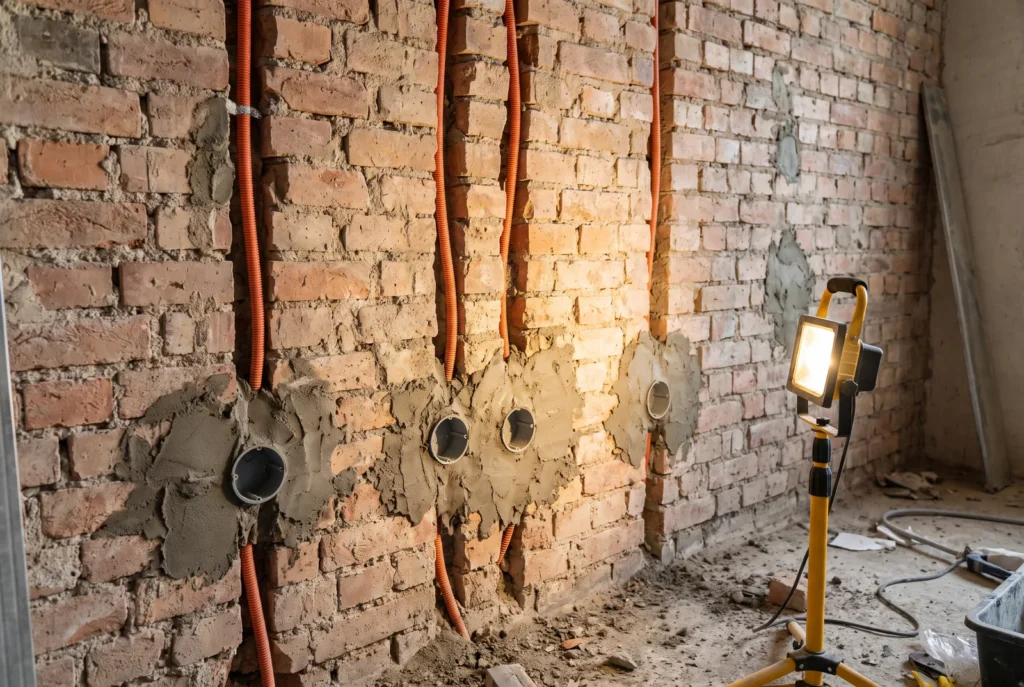
Burying the electrics means cutting into walls — and a wall deserves respect: limited depth, forbidden zones, careful refilling. The rules that avoid cracks (and the severed cable at the neighbour's first drill hole).
The permitted zones (diagram)
The rules in figures
- Depth: the chase must never reach the structural core — on a 50 mm partition, 30 mm max; on structural concrete, no chasing without an engineer's advice (prefer floors and ceilings).
- Never a diagonal chase — the tacit rule that lets anyone drill a wall without electrocution: cables run up, down or horizontally from a visible box.
- Flexible conduits: Ø 16 mm (2 × 1.5 mm² conductors), Ø 20 (3 × 2.5), Ø 25 (6 mm² hob). Max fill: one third of the section.
- In plasterboard: conduits run inside the partition through the stud knockouts — zero chasing. One of the big arguments for metal-frame walls.
- Refilling: plaster or suitable mortar, never finish filler alone in thickness.
- Airtight membrane boxes on insulated walls (vapour barrier continuity) — see internal insulation.
In the floor
Conduits crossing a room run around the perimeter or in a preparation layer before the screed — never across a future heated floor. They must be embedded and fixed before pouring: see screed or levelling compound.